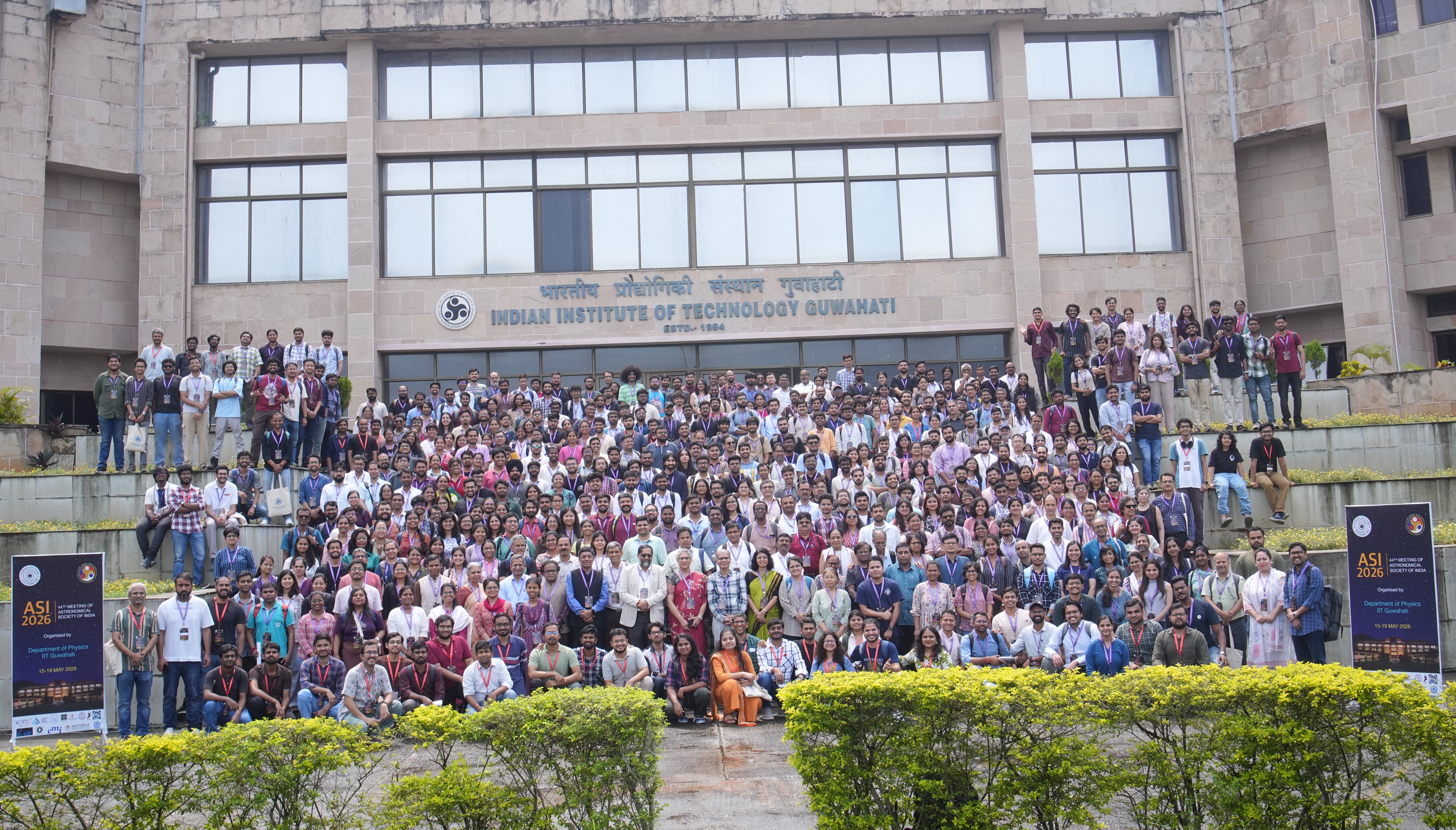
| Name: Anirban Kopty |
| Affiliation: Inter-University Centre for Astronomy and Astrophysics, Pune |
| Conference ID: ASI2026_158 |
| Title: Optimal cross-correlation technique to search for strongly lensed gravitational waves |
| Abstract Type: Oral |
| Abstract Category: Facilities, Technologies and Data science |
| Author(s) and Co-Author(s) with Affiliation: Anirban Kopty(Inter-University Centre for Astronomy and Astrophysics, Pune - 411007, India), Sanjit Mitra(Inter-University Centre for Astronomy and Astrophysics, Pune - 411007, India), Anupreeta More(Inter-University Centre for Astronomy and Astrophysics, Pune - 411007, India) |
| Abstract: As the number of detected gravitational wave (GW) events increases with the improved sensitivity of the observatories, detecting strongly lensed pairs of events is becoming a real possibility. Identifying such lensed pairs, however, remains challenging due to the computational cost and/or the reliance on prior knowledge of source parameters in existing methods. This study investigates a direct cross-correlation (CC) approach applied to strain data from pairs of detectors for Compact Binary Coalescence (CBC) events identified by GW searches, using an optimal, mildly model-dependent, low computation cost approach for identifying strongly lensed candidates. This technique efficiently narrows down the search space, allowing for more sensitive, but (much) higher latency, algorithms to refine the results further. We demonstrate that our method performs significantly better than other computationally inexpensive methods. Particularly, we achieve $96\% \, (80\%)$ lensed events detection at a pairwise false positive probability of $\sim 10\% \, (5\%)$ for a single detector with LIGO design sensitivity, assuming an SNR $\geqslant 10$ astrophysically motivated lensed and unlensed populations. Thus, this method, using a network of detectors and in conjunction with sky-localisation information, can enormously reduce the false positive probability, making it highly viable to efficiently and quickly search for lensing pairs among thousands of events, including the sub-threshold candidates. |