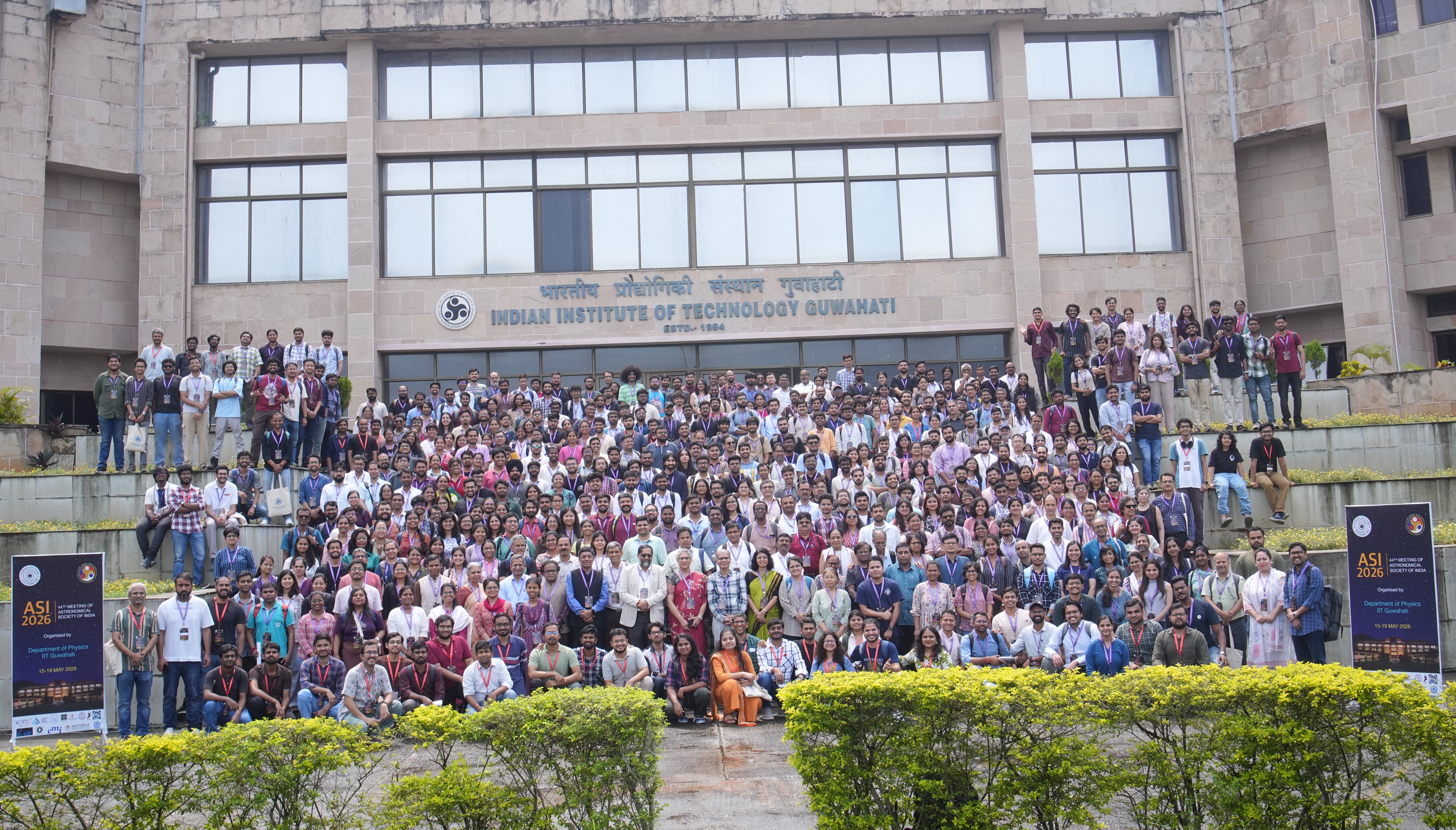
| Name: Rohit Chaudhary |
| Affiliation: Indian Institute of Science Education and Research Tirupati |
| Conference ID: ASI2026_659 |
| Title: Understanding the importance of magnetic fields in the “collect and collapse” model of star formation: a case study towards S104 |
| Abstract Type: Oral |
| Abstract Category: Stars, Interstellar Medium, and Astrochemistry in Milky Way |
| Author(s) and Co-Author(s) with Affiliation: Rohit Chaudhary(Indian Institute of Science Education and Research (IISER), Tirupati - 517619, India), Eswaraiah Chakali(Indian Institute of Science Education and Research (IISER), Mohali - 140306 India), Jessy Jose(Indian Institute of Science Education and Research (IISER), Tirupati - 517619, India), Manash R Samal(Physical Research Laboratory (PRL), Ahmedabad - 380009, India), Vineet Rawat(Korea Astronomy and Space Science Institute, Daejeon 34055, South Korea), Sandhyarani Panigrahy(Indian Institute of Science Education and Research (IISER), Tirupati - 517619, India) |
| Abstract: Magnetic fields (B-fields) play a crucial role in regulating star formation by mediating the complex interplay between gravity, turbulence, and stellar feedback. However, their influence in feedback-dominated environments remains poorly understood, including in HII regions where expanding ionization fronts (I-fronts) interact with magnetized molecular clouds. HII regions created by massive stars provide ideal laboratories for studying how B-fields influence shell fragmentation and subsequent triggered star formation. We present the results based on high-resolution (14”) 850 𝜇m dust continuum polarization observations using JCMT SCUBA-2/POL-2 towards two dense clumps located on the shell of the spherical HII bubble Sh2-104. B-fields in clump 1 exhibit two distinct components – one with 0±24° orientation, aligning the I-fronts, while the other with 125±40° appears to be perturbed by the Ultra-compact HII region formed within clump 1. To further examine the influence of the expanding HII region on the surrounding clumps and B-field morphology, we produced offset angle maps (Δθ) between the tangential orientation of the I-front and the B-field position angle, revealing preferential alignment with the I-front in clump 1 (except those around UCHII) and radial configurations in clump 2.
Our key findings: (i) Plane-of-sky B-fields strengths of 64±7 μG and 64±8 μG in clump 1 and 2, respectively, (ii) Magnetic pressures is either equipartition with (or marginally exceeds) turbulent pressure (PB/Pturb ≈ 1.1-1.5), (iii) Both clumps are magnetically supercritical or at critical state (λ = 3.4±1.5 and 1.8±0.4), indicating gravitational dominance over magnetic support at least in clump 1, and (iv) Sub-Alfvénic turbulence (MA ≈ 0.3-0.4) in both clumps suggest that B-fields regulate turbulent motions and stabilize clump morphology against feedback-driven instabilities. The combined thermal, turbulent, and magnetic support is insufficient to prevent gravitational collapse in clump 1 (critical mass ratios RC = 4.2 for clump 1), consistent with observed active star formation. |