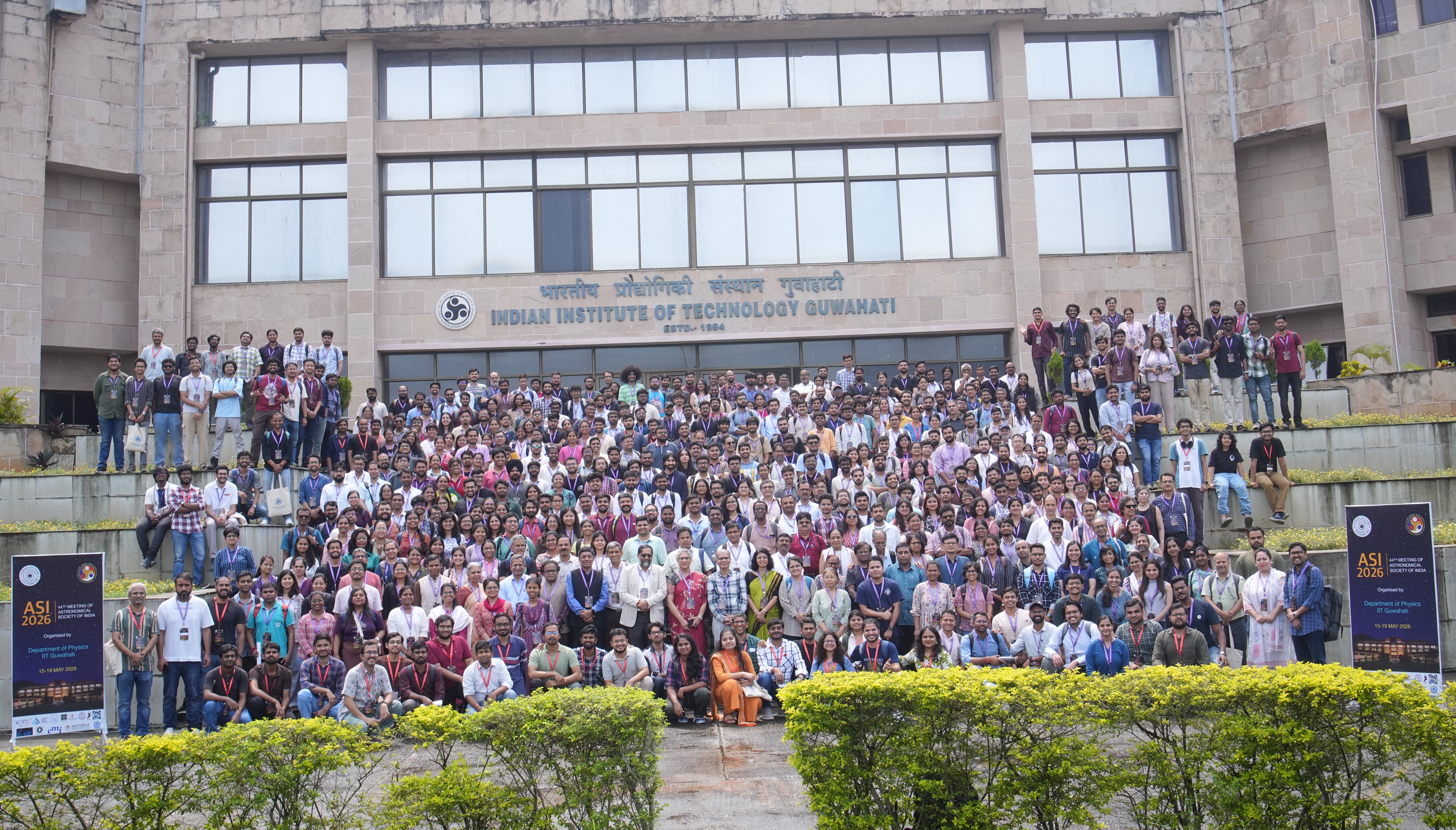
| Name: Sana Ahmed |
| Affiliation: Trinity College Dublin, Ireland |
| Conference ID: ASI2026_893 |
| Title: Tracing Exocometary Gas Release in the β Pictoris Debris Disk |
| Abstract Type: Oral |
| Abstract Category: Sun, Solar System, Exoplanets, and Astrobiology |
| Author(s) and Co-Author(s) with Affiliation: Sana Ahmed(Trinity College Dublin - D02 PN40, Ireland), Luca Matra(Trinity College Dublin - D02 PN40, Ireland) |
| Abstract: Debris disks are reservoirs of icy exocomets around stellar systems and are the extrasolar analogs of the Kuiper belt. These are the remnants of planet formation that are left behind after the star has evolved into the main sequence and the protoplanetary disk has dissipated. Exocomets collide and grind down to release dust that is detected through thermal emission. ALMA's advanced sensitivity has also resulted in the detection of gaseous emissions in over 20 disks. The gas release mechanisms include collisional vaporization of small grains and photodesorption from icy grains, different from the sublimation-driven release of volatiles in solar system comets. The molecular gas is dissociated rapidly by the radiation fields and the long lifetime of CO may explain why it is the only molecule detected so far. The detection of atomic N and S, besides C and O, in the β Pictoris disk suggests the release of molecules other than CO. We have modeled the atomic and CO molecular gas emission in the β Pictoris disk. To find the excitation conditions of the gas, we solve the energy balance by considering heating due to photoelectrons emitted from the dust and energy released due to photo-ionization/dissociation of the gas. Cooling in the gas occurs due to the collisional excitation of the fine structure atomic levels and the molecular rovibrational levels. We also solve the ionization balance in the gas by including recombination of ionized carbon to form neutral carbon, and the thermal collection of electrons on dust grains. Once the excitation conditions are known, we do a radiative transfer using the RADMC3D package to estimate the total flux. Using the observed emission flux from ALMA and Herschel, we do an MCMC fitting to our estimated flux to find the density structure and mass of the gas. |