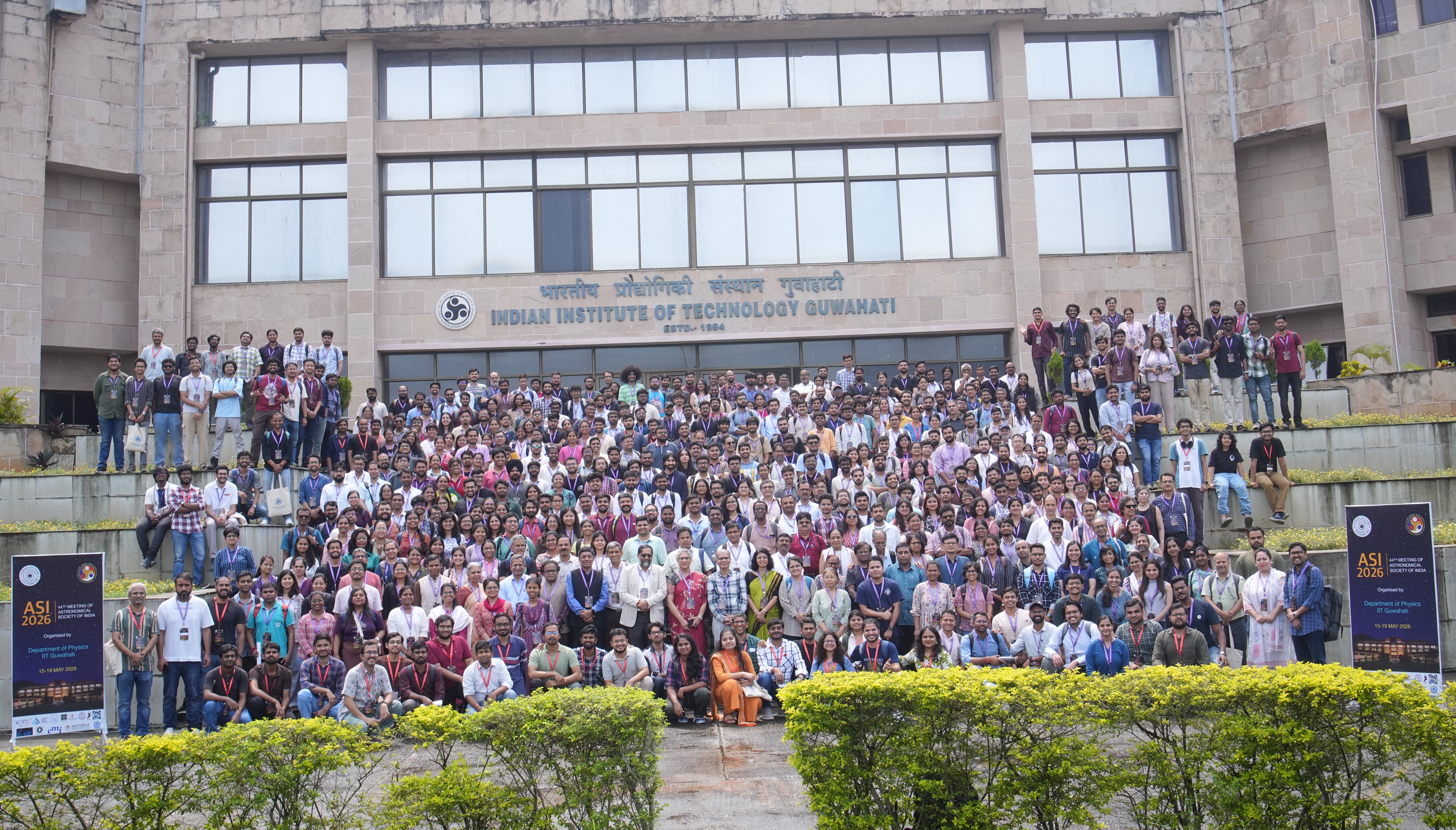
| Author(s) and Co-Author(s) with Affiliation: Mulchand Kurre(SoS in Physics and Astrophysics, Pt. Ravishankar Shukla University, Raipur, Chhattisgarh, 492010, India), D. K. Sahu(Indian Institute of Astrophysics, Koramangala II Block, Bengaluru 560034, India), Kripa Ram Sahu(SoS in Physics and Astrophysics, Pt. Ravishankar Shukla University, Raipur, Chhattisgarh, 492010, India), N. K. Chakradhari(SoS in Physics and Astrophysics, Pt. Ravishankar Shukla University, Raipur, Chhattisgarh, 492010, India), Rishabh Singh Teja(Tsung-Dao Lee Institute, Shanghai Jiao Tong University, No.1 Lisuo Road, Pudong New Area, Shanghai, China), G. C. Anupama(Indian Institute of Astrophysics, Koramangala II Block, Bengaluru 560034, India) |
| Abstract: We present optical photometry and medium-resolution spectroscopy of the Type Ib supernova SN 2024ahv hosted by galaxy NGC 6106. Our observations span from 6.65 to 223 days after first light. The absolute g-band magnitude at peak brightness is estimated as Mg = −16.84 ± 0.15 mag. Spectroscopic analysis reveals prominent features of He I, Si II, Ca II, Mg II, and Fe II, which are successfully reproduced using the spectral synthesis code SYNAPPS/SYN++. The velocities at g-band maximum light, inferred from the Si II and He I 5876 absorption minima, are approximately 7000 km s−1 and 11,000 km s−1, respectively, consistent with values observed in other Type Ib supernovae. From light curve modeling using MOSFiT, the mass of Ni56 and the ejected mass in the explosion are estimated to be 0.10 ± 0.02 M⊙ and 1.98 ± 0.28 M⊙, respectively. |