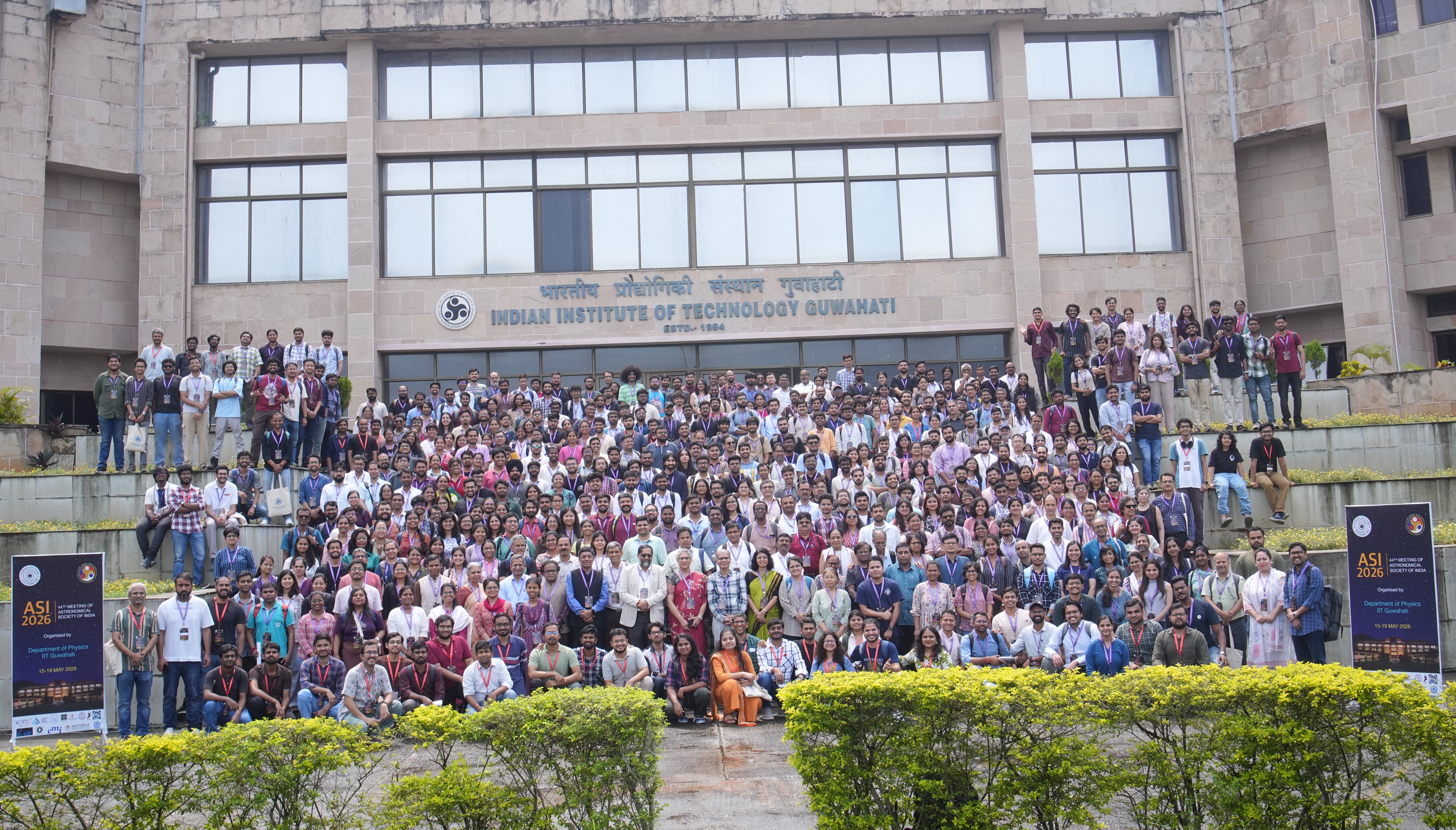
| Name: Abhisek Tamang |
| Affiliation: Indian Institute of Science & Raman Research Institute, Bangalore |
| Conference ID: ASI2026_160 |
| Title: Super-orbital period evolution of Her X-1 |
| Abstract Type: Oral |
| Abstract Category: High Energy Phenomena, Fundamental Physics and Astronomy |
| Author(s) and Co-Author(s) with Affiliation: Abhisek Tamang(Indian Institute of Science & Raman Research Institute, Bangalore - 560080, India), Hemanth Manikantan(INAF - Istituto di Astrofisica e Planetologia Spaziali, Via del Fosso del Cavaliere, 100, 00133 Roma, Italy), Kinjal Roy(Raman Research Institute, Bangalore-560080, India), Ajith Balu(Raman Research Institute, Bangalore-560080, India), Biswajit Paul(Raman Research Institute, Bangalore-560080, India) |
| Abstract: Her X-1 is an intermediate (or low) mass X-ray binary pulsar that exhibits a ~35-day super-orbital modulation whose origin-disc precession or neutron-star free precession-remains debated. Earlier work reported stochastic variations without a clear long-term trend. Using ~50 years of data from CGRO/BATSE, RXTE /ASM, Swift/BAT, Fermi/GBM, and MAXI /GSC supplemented with archival measurements, we studied the long-term evolution of this modulation. Three methods are applied: epoch-folding searches for constant periods, Chi-square maximisation in the period-period- derivative space, and timing of main-on peaks via an O-C analysis. All approaches consistently show a long-term decrease in the super-orbital period at a rate of ~ -10^5 s/s, with additional short-timescale variabilities superposed on this trend. The possible mechanisms for the observed decay of the super-orbital period will be discussed. |