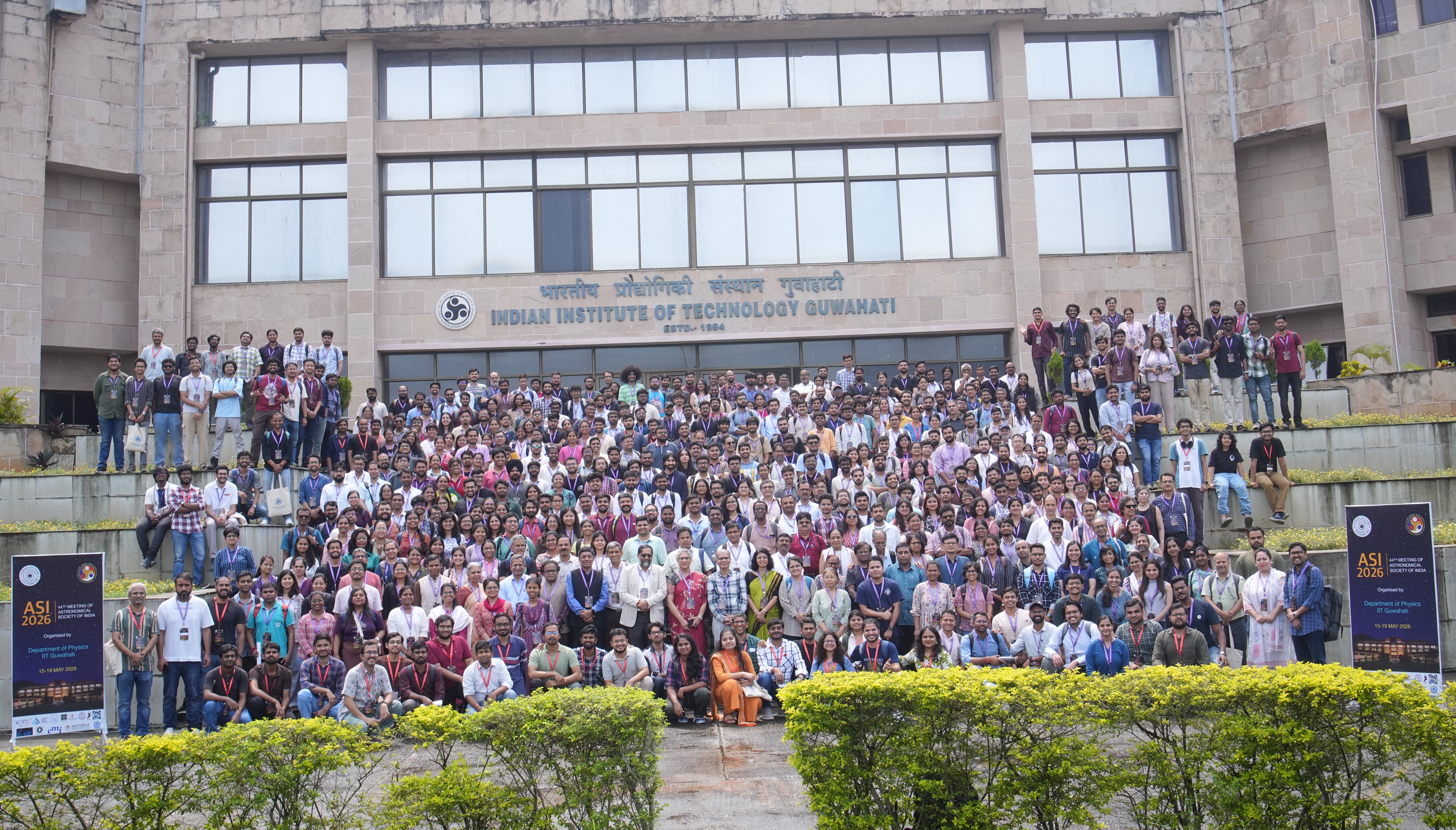
| Name: Prasanta Bera |
| Affiliation: BHU, Varanasi |
| Conference ID: ASI2026_643 |
| Title: Mass radius relation of rocky planets |
| Abstract Type: Oral |
| Abstract Category: Sun, Solar System, Exoplanets, and Astrobiology |
| Author(s) and Co-Author(s) with Affiliation: Prasanta Bera(Department of Physics, ISc, BHU, Varanasi 221005, India) |
| Abstract: The mass-radius (M-R) relationship is a fundamental framework in planet study used to characterize the internal composition and structural integrity of terrestrial bodies. For rocky planets, this relationship is primarily governed by the Equations of State (EoS) of high-pressure mineral phases, typically modeled through a differentiated structure consisting of an iron-rich core and a silicate mantle. Theoretical models indicate that for a fixed chemical composition, the radius scales approximately as $R \propto M^{0.27}$. However, significant deviations occur based on the Core-Mass Fraction (CMF). Here, we examine the inherent degeneracies in M-R diagrams, where different ratios of water ice, silicates, and metals can yield identical observational signatures. By constraining these relations with stellar abundance data and thermal evolution models, we can distinguish between rocky planets and volatile-rich ocean planets. |