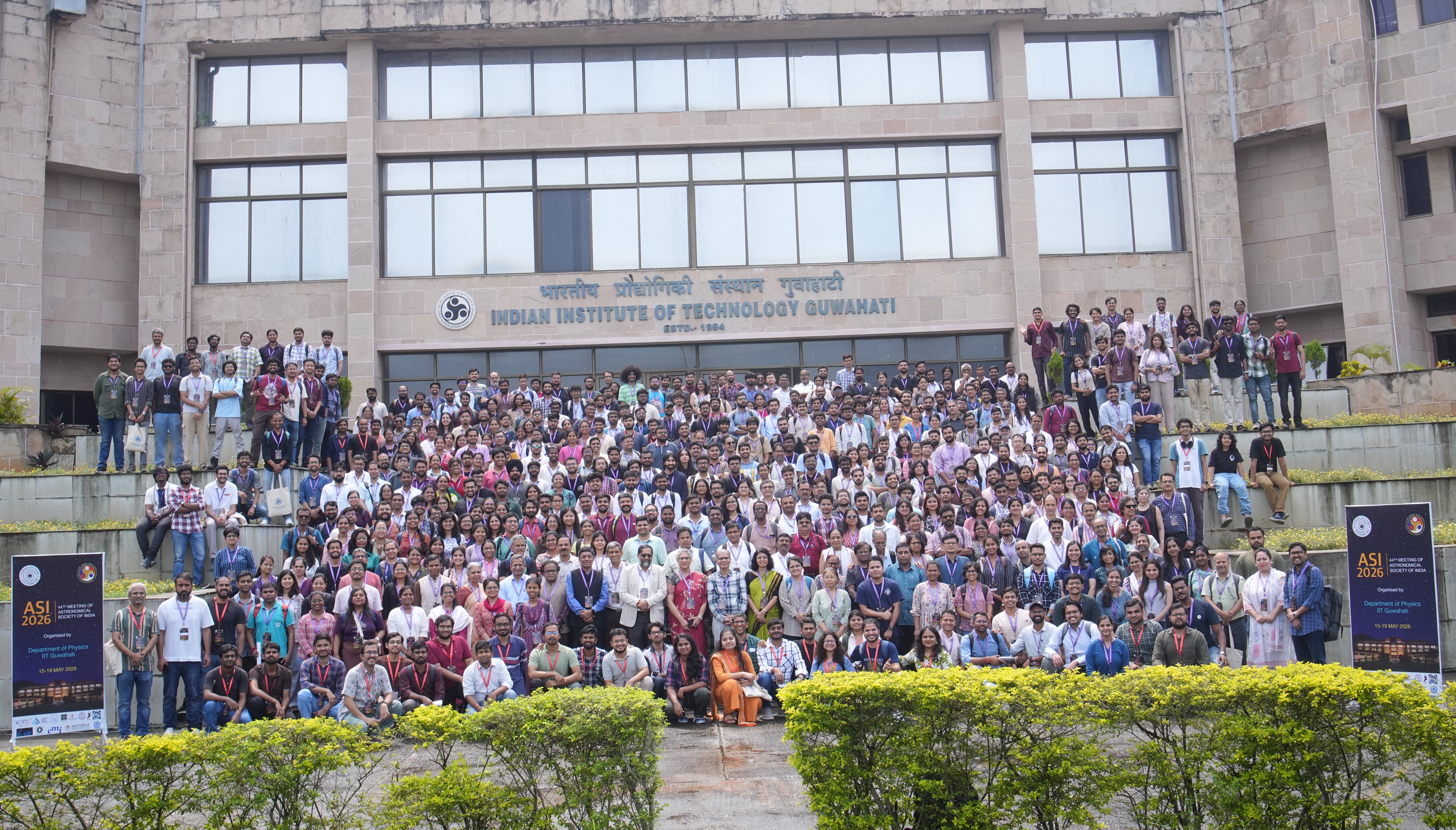
| Name: Jay Verma Trivedi |
| Affiliation: International centre for space and cosmology, school of arts and sciences, ahmedabad university |
| Conference ID: ASI2026_752 |
| Title: Observational aspects of singularities |
| Abstract Type: Poster |
| Abstract Category: High Energy Phenomena, Fundamental Physics and Astronomy |
| Author(s) and Co-Author(s) with Affiliation: Jay Verma Trivedi(International Centre for Space and Cosmology, School of Arts and Sciences, Ahmedabad University) |
| Abstract: The cosmic censorship conjecture remains one of the most fundamental yet unresolved problems in theoretical astrophysics. Despite decades of study, it has neither been rigorously proven nor precisely formulated. Classical gravitational collapse models have shown that naked singularities can form generically under physically reasonable conditions, posing a direct challenge to the conjecture. However, establishing their physical relevance ultimately requires observational confirmation.
Recent results from the Event Horizon Telescope (EHT) collaboration have highlighted the Joshi–Malafarina–Narayan (JMN1) naked singularity spacetime as one of the most compelling black hole mimickers, motivating a deeper investigation of observable differences between black holes and naked singularities. This makes it crucial to identify robust observational signatures that can distinguish these two classes of compact objects.
In this work, we investigate gravitational collapse scenarios that lead to naked singularities and compare their astrophysical properties with those of black holes. We focus on identifying distinguishable features arising from the spacetime geometry, particularly through the properties of accretion disks. Differences in radiative efficiency, luminosity profiles, and inner disk behavior provide potential observational markers that could help discriminate between black holes and naked singularities.
We also explore the broader astrophysical implications of naked singularities, including their possible impact on galaxy evolution through enhanced energy release and feedback mechanisms. Our results suggest that naked singularities, if realized in nature, may leave observable imprints distinct from those of black holes, providing a promising avenue for testing the cosmic censorship conjecture using current and future astronomical observations. |