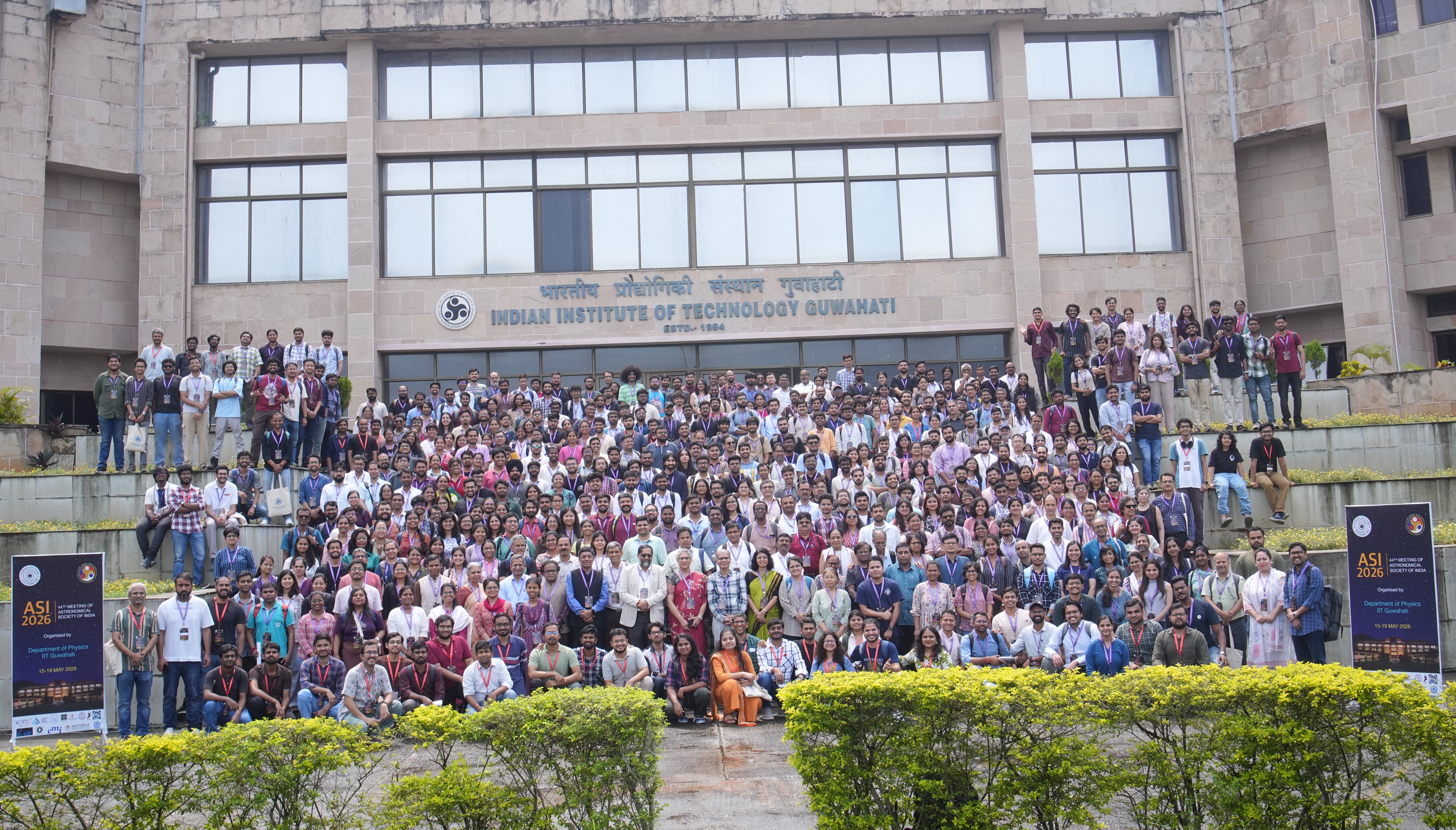
| Name: Shubham Sati |
| Affiliation: Inter-University Centre for Astronomy and Astrophysics |
| Conference ID: ASI2026_89 |
| Title: Weak lensing Signal around an Isolated Galaxy |
| Abstract Type: Poster |
| Abstract Category: Galaxies and Cosmology |
| Author(s) and Co-Author(s) with Affiliation: Shubham Sati(Inter-University Centre for Astronomy and Astrophysics, Pune - 411007, India), Surhud More(Inter-University Centre for Astronomy and Astrophysics, Pune - 411007, India) |
| Abstract: We present a measurement and modelling of the weak gravitational lensing signal around isolated galaxies using spectroscopic lens data from the Dark Energy Spectroscopic Instrument (DESI) Year 1 Bright Galaxy Survey and background source galaxies from the Hyper Suprime-Cam (HSC) Year 3 weak-lensing shape catalogue. The analysis is based on stacked galaxy–galaxy lensing measurements of the excess surface mass density profile, ΔΣ(R), over projected radii from sub-Mpc to multi-Mpc scales.
A primary technical component of this work is the construction of a clean, isolated lens sample. We define volume-limited subsamples of DESI BGS galaxies and apply isolation criteria based on projected separation (1–3 Mpc), line-of-sight velocity difference, and relative luminosity thresholds for neighbouring galaxies. These cuts are implemented using spatial indexing and neighbour searches to suppress contamination from nearby halos and ensure that the central galaxy dominates the lensing signal.
The weak-lensing signal is measured by pairing each lens with background HSC sources selected via photometric redshifts. Tangential ellipticities are computed relative to the lens–source separation vector and combined using inverse critical surface density weighting and shear responsivity corrections. Radial binning is performed in projected comoving distance, and ΔΣ(R) is estimated as a weighted average over all contributing lens–source pairs.
The measured ΔΣ(R) profiles are compared to predictions from the Singular Isothermal Sphere (SIS) model. Systematic checks, including cross-shear measurements and lensing around random points, are consistent with zero signal. These results demonstrate the robustness of the data selection and measurement pipeline, providing a foundation for future analyses with improved error estimation and larger sample sizes. |