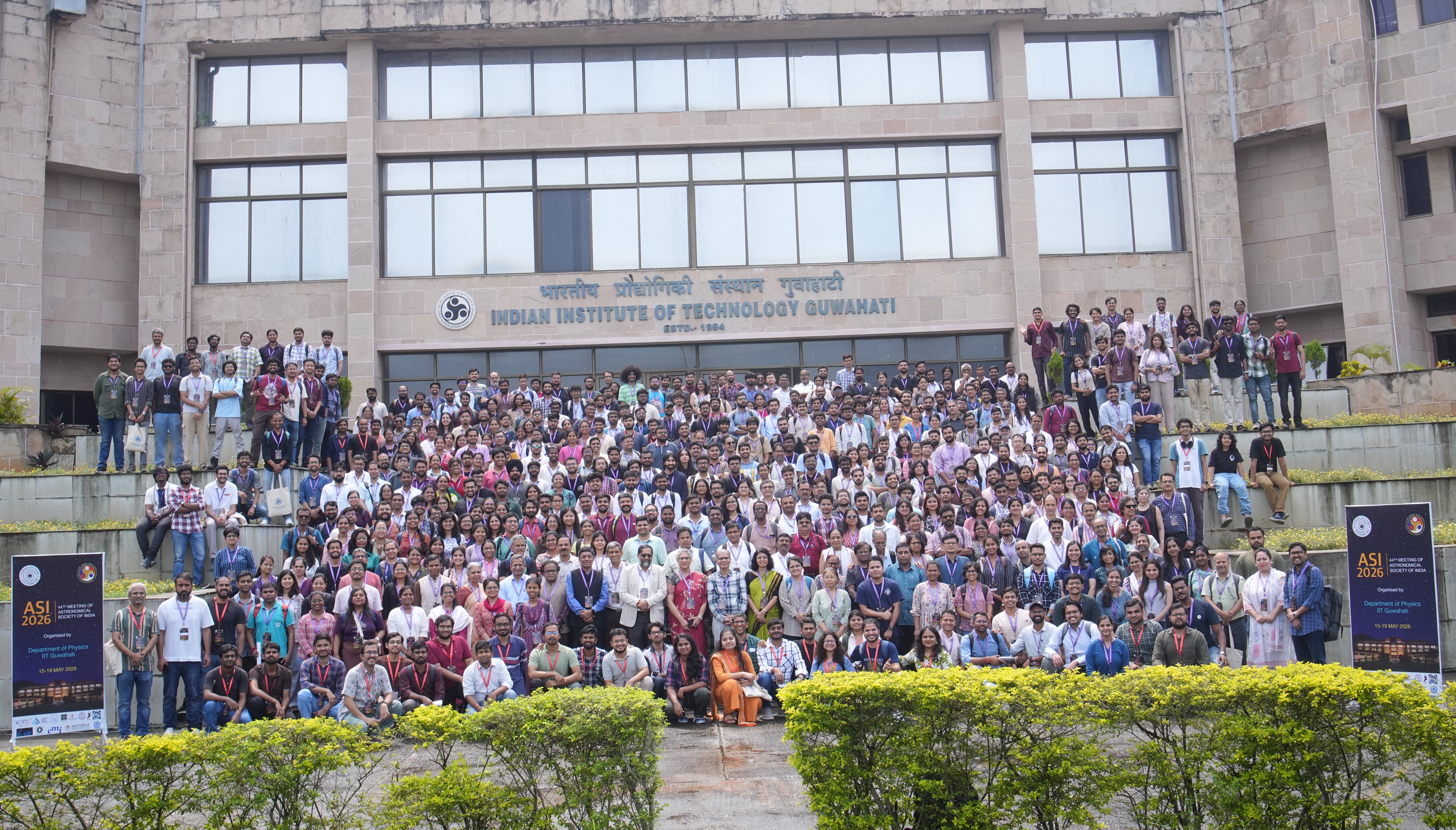
| Name: Abhay Kumar Prusty |
| Affiliation: Indian Institute of Science Education and Research, Kolkata |
| Conference ID: ASI2026_985 |
| Title: Intra-night chromospheric variability in a young M dwarf |
| Abstract Type: Poster |
| Abstract Category: Sun, Solar System, Exoplanets, and Astrobiology |
| Author(s) and Co-Author(s) with Affiliation: Suman Sourav Biswal(Indian Institute of Science Education and Research Berhampur, Berhampur - 760010, India), Abhay Kumr Prusty(Indian Institute of Science Education and Research Kolkata, Mohanpur - 741246, India), Priyanka Chaturvedi(Tata Institute of Fundamental Research, Mumbai - 400005, India) |
| Abstract: Young M dwarfs exhibit strong magnetic activity that can produce rapidly varying chromospheric emission on short timescales. We present time-resolved, low-resolution optical spectroscopy of the young M dwarf 2MASS J16111534 - 1757214 obtained over a single night using the Hanle Faint Optical Spectrograph and Camera (HFOSC) on the 2-m Himalayan Chandra Telescope (HCT) in Ladakh, India. This observation forms part of the SAYS (Stellar Activity in Young Stars) survey, a broader effort to characterize chromospheric variability in young low-mass stars. The target is a very young M dwarf, making it a valuable case for probing chromospheric behaviour at early evolutionary stages. We examine the temporal evolution of Balmer emission line ratios (H_alpha/H_beta, H_alpha/H_beta, and H_beta/H_gamma) as diagnostics of chromospheric conditions. Significant variability is detected on timescales of tens of minutes, with a systematic decrease in H_alpha/H_beta and H_alpha/H_gamma, while H_beta/H_gamma remains comparatively stable. This behaviour suggests changes in optical depth and emitting column density within a dense chromosphere rather than simple temperature variations. The observed variability is consistent with flare-related or post-flare activity. Our results demonstrate that even short spectroscopic time series can capture complex and evolving chromospheric states in young M dwarfs, highlighting the importance of time-resolved observations for interpreting stellar activity diagnostics. |