Lunar Eclipse - 8 November 2022
See the Moon as a Crescent or a Total Lunar Eclipse during Today's Full Moon!
"On behalf of the Astronomy and Astrophysics community of India, we encourage you to go out and enjoy the celestial spectacle of the lunar eclipse. The ASI Public Outreach and Education Committee has put together resources here from various Astronomy Organizations and Science Outreach Centres for the public."
- Virendra Yadav, Co-Chair, Public Outreach and Education Committee, Astronomical Society of India.
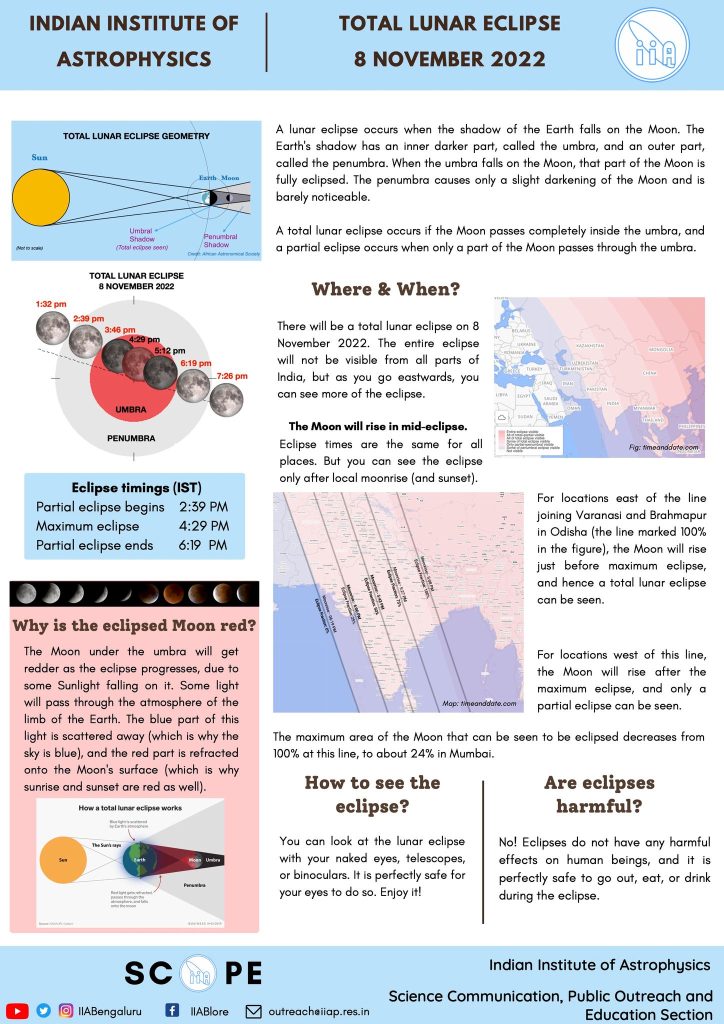
Infographic courtesy: IIA, Bengaluru. Tamil and Kannada versions are also available.
As the Moon rises on 8th November this year in the eastern sky, we will see a celestial game of shadows unfold - the Sun, Earth and the Moon lining up to make a Lunar Eclipse. Though this is a Total Lunar Eclipse, from most parts of India it will be observed as a Partial Lunar Eclipse only as the moon is going to rise during or after the total phase and will be very low in the sky. This means that the Moon may not be visible untill its higher up in the sky when it may not be completely obscured by the Earth's Shadow. During a Total Lunar Eclipse, the appears blood red in colour as it is dimly lit by sunlight passing through the Earth's Atmosphere and getting scattered. During the partial phase, the darker shadow (Umbra) of the Earth partially covers the Moon. As a result, the Moon looks similar to a crescent even on a full moon night. The eastern parts of India will experience a deeper eclipse.
This spectacle, coming soon after the solar eclipse of 25 October, 2022 is a good reason for all to go outside, watch the lunar eclipse and enjoy some snacks. Do invite all your friends, family, and your communities to see it too. All relevant information is available here to see the event and learn some facts about eclipses - which have been known to be harmless, natural phenomena right from the times of Āryabhaṭa! In case you are unable to go outside to watch the eclipse or want to see the total eclipse, you can see its live streaming from various parts of the country and the world.
Join us to celebrate & share this wonder
The ASI-POEC has created a resource base on this page for anyone to see and share the eclipse. Scroll below for Maps and Tables, Teaching resources, and a Glossary.
MAPS, TIMINGS, LOCATIONS
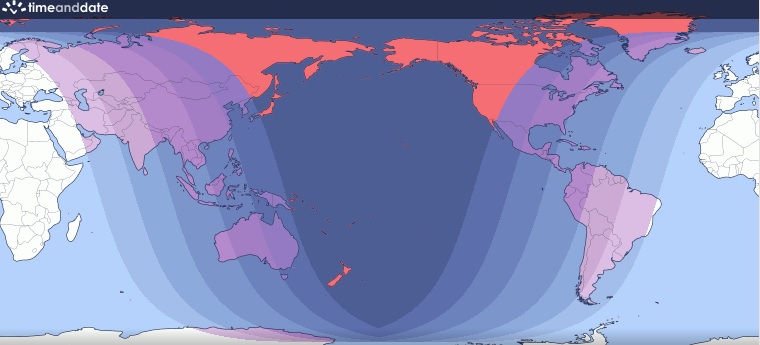
Click here for larger interactive map of the Lunar Eclipse visibility.
Credit: timeanddate.com
The timings and maximum fraction of the Moon's diameter that will be obscured by the Earth's shadow (called Magnitude) will differ with your location. It is given below for a few cities in various parts of India:
| City | Moonrise Time | Maxima Time | Eclipse magnitude |
| Guwahati | 16:32 IST | 16:35 IST | > 1 (Total Eclipse) |
| Kolkata | 16:52 IST | 16:54 IST | > 1 (Total Eclipse) |
| Varanasi | 17:09 IST | 17:12 IST | 0.991 |
| Nainital | 17:17 IST | 17:20 IST | 0.88 |
| New Delhi | 17:28 IST | 17:31 IST | 0.728 |
| Vijayawada | 17:37 IST | 17:34 IST | 0.673 |
| Bhopal | 17:36 IST | 17:38 IST | 0.619 |
| Hyderabad | 17:40 IST | 17:42 IST | 0.556 |
| Chennai | 17:38 IST | 17:42 IST | 0.556 |
| Bengaluru | 17:49 IST | 17:57 IST | 0.338 |
| Mumbai | 18:01 IST | 18:03 IST | 0.239 |
| Rajkot | 18:04 IST | 18:06 IST | 0.189 |
To figure out which stages of the eclipse you can see, use this handy interactive map by timeanddate.com.
Live Webcasts (planned)
If you have clouds, you may find these live streaming links useful.
What will I see … & is it ok to see it?
Yes! It is absolutely okay and safe to see the lunar eclipse, and share the joy of the event with people you know. Unlike solar eclipse, no special equipment is required and you can see the lunar eclipse even with naked eyes. If you have a telescope or binocular then you can use that also.
You may hear that one should stay indoors, and not cook or eat during an eclipse. These kinds of beliefs are common around the world but they have no basis in science. They come from an age when humans did not understand the sky and were easily frightened by eclipses. We would do well to follow the great astronomer Aryabhata (476-550 C.E.) who gave the correct explanation of eclipses as well as a method to calculate them, and did not believe in any of the myths surrounding these events. For further reading on Aryabhata, eclipses, and myths versus science, read this article. So you can even eat during the eclipse. In short, there are no harmful effects from seeing the lunar eclipse.
An eclipse is one of the most grand and awe-inspiring spectacles that nature has to offer us. Why would we not want to see it?
MORE USEFUL RESOURCES
Countering Pseudoscience and Misconceptions
- Who is afraid of Eclipses (by Aniket Sule, ASI-POEC) (500 KB)
What do these terms mean?
Umbra: Darker part of the Earth's shadow falling on the Moon.
Penumbra: Lighter part of the Earth's shadow falling on the Moon. A Penumbral Lunar Eclipse is usually not detectable from naked eyes as the shadow is very faint.
Total lunar eclipse: When the Moon is fully within Umbra, we see a total lunar eclipse. The Moon appears various shades of blood red to dark copper during the totality. It can last for up to more than an hour depending on the orbital geometry of the Sun, Earth and Moon.
Partial lunar eclipse: When the Moon is partially within Umbra, we see a partial lunar eclipse. During the partial phase the Moon appears similar to a crescent even on full moon night. This phase also can last up to an hour.
Magnitude: Fraction of the Moon's diameter obscured by the Earth's Umbra.